
Guide · Warranty
Why warranty claims get denied, and how to write a cause and correction that holds up
The short answer
Most warranty claim denials trace back to the repair order story. The cause repeats the customer’s concern, or names the part but not the failure. The correction does not match the operation and parts billed, or the diagnosis, bulletin or approval behind the repair never made it onto the RO. The manufacturer pays for a failure it can see on paper, so the story has to show it.
A cause that holds up says how the part failed and how the technician confirmed it. A correction that holds up says what was done and matches the line it sits on. Both have to be right before the RO closes: a warranty administrator can edit what is submitted, but the RO stays the way it closed.
Denied now, or charged back later
A weak story costs a dealership in two ways. Before payment, the claim can come back denied or returned, and the warranty office spends time reworking it, if it can be saved at all. After payment, the same weak story can be charged back in a warranty audit, when the auditor reads the RO against what was paid. Many stores call that a debit. The fix for both is the same: a complete story on the open RO.
For what auditors pull and how to run a self-audit, see how to avoid warranty audit chargebacks and debits.
Common reasons a claim gets denied
| Reason | What it looks like on the RO |
|---|---|
| Cause restates the concern | The customer said the horn does not work, and the cause says the horn does not work. |
| Cause names the part, not the failure | “Found horn bad” or “manifold leaking” tells the manufacturer which part, not how it failed. |
| No diagnosis on the line | No test, reading or trouble code shows how the failure was confirmed. |
| Correction does not match the claim | The work described differs from the labor operation or the parts billed, or the correction is missing. |
| Bulletin missing or outside its scope | The repair follows a service bulletin that is not named, or the vehicle falls outside the models, years or conditions the bulletin covers. |
| Approval or document missing | No customer signature or note of a phone approval, no prior approval reference, no sublet invoice. |
How to write each part of the story
Concern or complaint
Manufacturers differ on the name: some say concern, others say complaint. Whichever yours uses, write what the customer reported, in plain words, with the conditions: when it happens, how often, at what speed or temperature. The concern is what the cause has to answer.
Cause
The cause is where technicians most often fall short. The two usual misses are restating the concern and writing down only what was found. A complete cause does two things:
- It says how the part failed. Cracked, open internally, worn through, shorted: the failure mode, not just the part name.
- It shows how the failure was confirmed. The test that was run, the reading that was taken or the trouble code that was set.
Two examples, from weak to complete. These are written for this guide, not taken from a real repair order.
| Concern | Restates the concern | Only what was found | Complete cause |
|---|---|---|---|
| Horn does not work. | “Horn inoperative.” | “Found horn bad.” | “Verified horn inoperative. Relay clicks and battery voltage reaches the horn connector with the pad pressed. Horn does not sound with power applied directly. Horn coil open internally.” |
| Ticking noise from the engine on a cold start. | “Engine ticks when cold.” | “Found exhaust manifold leaking.” | “Verified ticking on a cold start that fades as the engine warms. Inspected cold: exhaust manifold cracked between two runners, with a soot trail at the crack. The crack opens when cold and lets exhaust escape.” |
A quick test for any cause: cover the concern and read the cause on its own. If it does not tell you how the part failed and how anyone knows, it is not finished.
Correction
The correction says what was done to fix the failure in the cause, and it has to agree with the line: the labor operation billed, the parts on the line and, when a service bulletin applies, the bulletin number. “Replaced horn assembly, horn operates normally” is a correction. It belongs in the correction, not in the cause.
Five checks on each warranty line while the RO is open
Whoever reads warranty lines before close, the shop foreman, the advisor or the service manager, can run these in a minute. None of them needs a technician’s training.
- The concern is in the customer’s words. It says what happens and when.
- The cause answers the concern with a failure mode. Not the concern again, and not just a part name.
- The cause shows the diagnosis. A test, a reading or a trouble code is on the line.
- The correction matches the claim. The operation, the parts and any bulletin number agree with what was done.
- The paperwork is on the RO. Customer approvals, prior approval references and sublet invoices are noted while the car is still in the shop.
When the same miss keeps showing up, fix it at the source: show the technician their own line next to a complete one, with names covered, and agree on the words for that job.
Write the repeat jobs once
Every service department fixes the same warranty repairs again and again. A cause and correction that the warranty office accepts for each of those jobs saves rewriting the story every time and keeps every write-up as strong as the best one. Use it as a starting point, never a shortcut past the diagnosis: when the car in the bay shows something different, write what that car shows.
Where DealerNavi fits
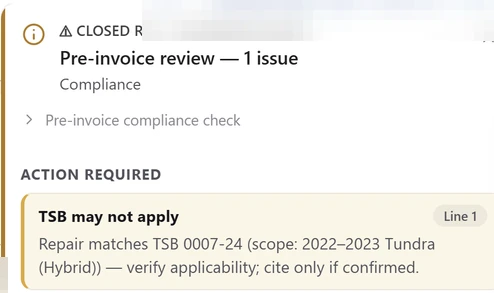
DealerNavi sits on top of the screens your team already uses and can be programmed to read any DMS or scheduling software. It turns the manufacturer’s requirements into guidance on the open RO, so a weak story gets fixed while the car and the technician are still there.
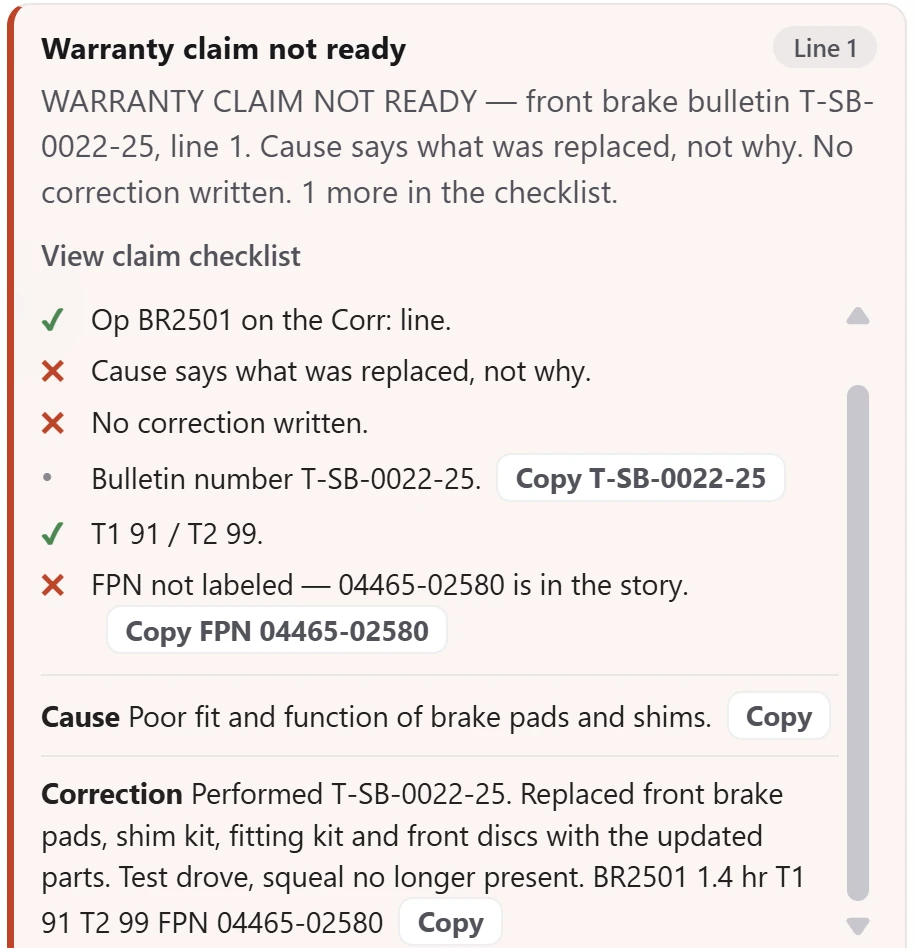
DealerNavi flags a missing cause or correction, a bulletin that applies but is not named in the correction, and a required trouble code that is not in the correction. For supported repairs, the warranty card shows which claim details are complete and which are missing, with cause and correction text ready to copy onto the repair order. DealerNavi lets you build reusable warranty repair templates for work your team sees repeatedly.
For the service manager, the coaching report shows recurring issues by advisor, and the weekly trend shows whether a habit is improving.
No checklist or tool can guarantee a claim is paid; the manufacturer makes that call. Catching an incomplete story before the RO closes can help reduce avoidable claim denials and later audit chargebacks.
Get in touch See the walkthrough
Questions service managers ask
Why do dealership warranty claims get denied?
Most often because the repair order does not tell a complete story: a cause that repeats the concern or only names the part, no diagnosis on the line, a correction that does not match the operation or parts billed, a bulletin that is missing or does not cover the vehicle, or a missing approval or document.
What is the difference between the cause and the correction?
The cause says how the part failed and how the technician confirmed it. The correction says what was done to fix it. “Replaced the part” is a correction, not a cause.
Is it the concern or the complaint?
Both are used, depending on the manufacturer. Use the word yours uses; either way it is what the customer reported, and the cause has to answer it.
What makes a warranty cause complete?
It answers the concern with the failure mode, how the part failed rather than which part failed, and it shows the test, reading or trouble code that confirmed it.
Can a denied claim be fixed after the RO closes?
The warranty administrator can edit what is submitted to the manufacturer, but the RO stays the way it closed, and it is the RO an auditor reads later. That is why the story has to be complete before the RO closes.
Can software make sure every warranty claim gets paid?
No tool can guarantee claim payment; the manufacturer makes that call. DealerNavi helps on the open RO: it flags a missing cause or correction, a bulletin that applies but is not named and a required trouble code that is missing, and for supported repairs shows cause and correction text ready to copy. That can help reduce avoidable denials.
More guides
- How to catch warranty mistakes before the RO closes
- How to improve service CSI and CXI scores, starting at booking
- How to avoid warranty audit chargebacks and debits: a service manager’s checklist
- How to train new service advisors and BDC reps to work like veterans
- How to stop wrong pay types on repair orders, including warranty rental