
Guide · Warranty
How to avoid warranty audit chargebacks: a service manager’s checklist
The short answer
A warranty audit chargeback happens when the repair order behind a paid claim does not support what the manufacturer paid. You avoid most of them in two places: on the open RO, where a missing story, operation code or signature can still be fixed, and in a regular self-audit of paid claims, where you find the patterns before an auditor does.
Timing matters because a closed RO is final. Once the RO is closed and the car is gone, there is no reopening it to make the fix. A single audit can cost a dealership anywhere from $10,000 to hundreds of thousands of dollars in chargebacks, and the money is usually lost on small gaps repeated across many ROs, not on one bad claim.
How a warranty audit works
The manufacturer pays the claim first and checks it later. In an audit, the auditor pulls paid warranty repair orders, on paper or scanned, and compares each one with the claim that was submitted and the manufacturer’s warranty policy. Any claim the RO does not support can be charged back, along with a long list of other reasons. Depending on the manufacturer’s policy, findings in a sample can also be applied to similar claims beyond the ones that were pulled.
The RO is the record that counts. A warranty administrator can change or edit what is submitted to the manufacturer, but the RO stays the way it closed, and manufacturers also have access to the dealership’s DMS data. Fixing a claim in the warranty office does not fix the RO the auditor will read.
The stakes are real. We’ve seen a single store charged back more than $250,000 in one warranty audit. That figure comes from 30 years of fixed ops experience, not from a DealerNavi result. Some manufacturers also score dealers on warranty measures and use that score when choosing which stores to audit. Your manufacturer’s warranty policy manual is the rulebook; read its audit section with your warranty administrator before you need it.
What gets charged back
These findings show up again and again. Each one is easy to fix while the RO is open and out of reach once it closes.
1. The claim story is incomplete
Every warranty line needs a concern or complaint, a cause and a correction. The cause has to say why the part failed and show the diagnosis behind it: the codes, the tests and the readings.
The most common miss is a cause that restates the concern, or one that only says what the technician found:
- Concern: “Coolant leak.” Cause: “Coolant leaking.” That restates the concern.
- Cause: “Found water pump leaking.” That says what was found, not why the part failed or how it was confirmed.
- Cause: “Pressure tested cooling system. Coolant leaking from water pump weep hole. Water pump internal seal deformed and lost its tension.” That shows the test and how the part failed. “Seal failed” would only say what failed, not how.
“Replaced water pump” is a correction, not a cause.
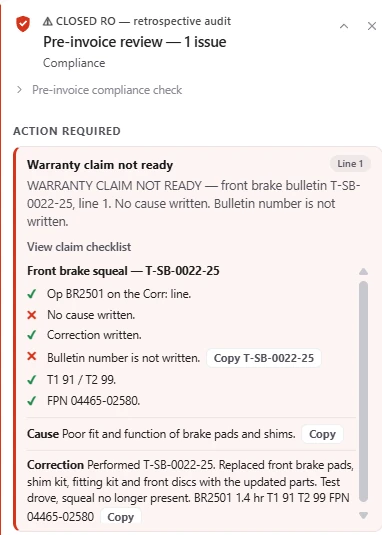
DealerNavi flags a missing cause or correction, a bulletin that applies but is not named in the correction, and a required trouble code that is not in the correction.
2. The bulletin or campaign does not cover the vehicle
If the claim cites a service bulletin, the story should show the bulletin was followed, and the vehicle has to fall inside its scope: the models, years and conditions it covers. A bulletin or campaign billed on a vehicle it does not cover is the kind of mismatch an audit is built to find.
DealerNavi flags a campaign billed on a vehicle it does not cover, a campaign that is expired or restricted, and a bulletin operation billed on a vehicle the bulletin does not cover.
3. The operation code does not match the work
The labor operation billed has to match the repair described, including the right variant. A campaign on the line without its operation code in the correction is easy to miss at a busy desk.
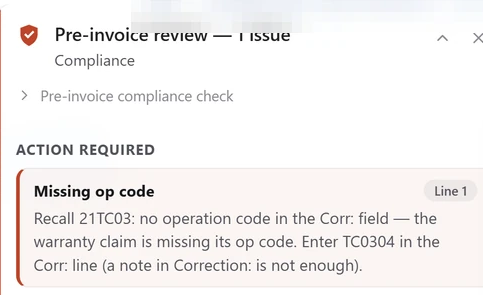
DealerNavi flags a wrong or missing campaign operation, asks the employee to verify an operation-code variant, and flags a warranty line missing its operation, time or failed part number.
4. The time does not support the claim
Auditors look for technician time punched to the line that supports the hours claimed. Missing punches, hours with no correction behind them, the same hours flagged twice, or clocked time far below the paid hours are a common debit.
DealerNavi flags warranty time with no correction row, flagged hours that differ from book time, clocked time less than half the paid hours, and the same technician flagging the same hours twice.
5. Added work was not authorized
Additional repairs need the customer’s approval, and some manufacturers require a manager’s authorization on certain work. A missing signature, or a phone approval with no note of who approved it and when, is a finding even when the repair was right.
6. Parts do not support the claim
The parts on the claim should fit the vehicle and sit on the right line. One-time-use parts the repair procedure says to replace should be replaced and charged, and replaced parts should be tagged and kept as long as the manufacturer requires.
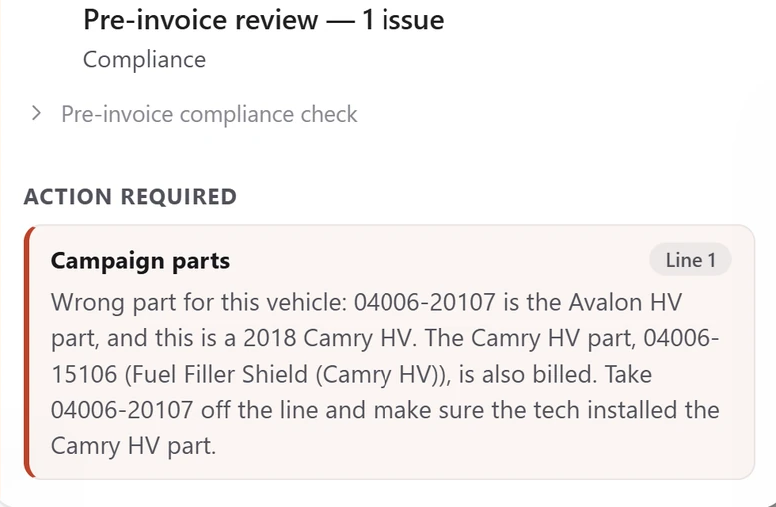
DealerNavi flags parts that are missing, extra, superseded or on the wrong line, and its wrong-part warning tells the employee what to remove and what to verify.
7. Supporting documents are missing
Sublet work needs its invoice. Some repairs need extra details, such as the original install information and the old part number on a replaced battery. Prior approvals need their reference on the claim. These are easy to capture while the work is in the shop and hard to find months later.
DealerNavi’s warranty checklist shows which replacement details are complete and which are still missing.
8. The pay type is wrong
A service contract approval billed as factory warranty, a warranty story sitting on customer pay, or a rental billed to warranty without its agreement number all invite questions about the whole RO.
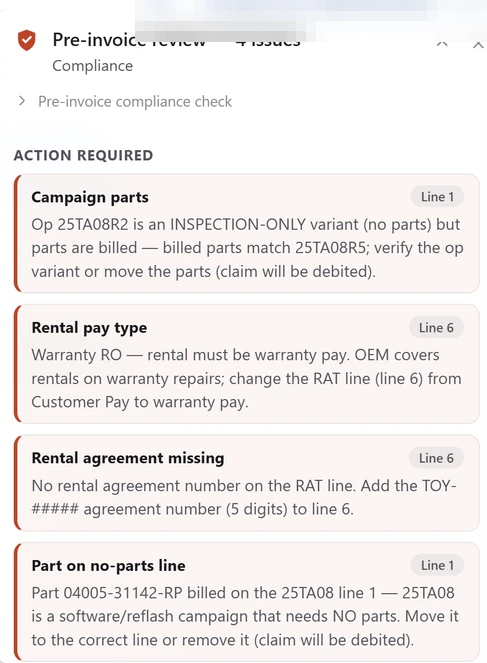
DealerNavi flags the wrong pay type across warranty, customer pay, prepaid maintenance and service contract, a rental on the wrong pay type, and a rental missing its agreement number.
No checklist or tool can guarantee a claim is paid or how an audit turns out; the manufacturer makes those calls. Catching these gaps before the RO closes can help reduce avoidable claim denials and later audit chargebacks.
A monthly self-audit any store can run
The open RO is where gaps get fixed. The self-audit is where you find the ones that got through, so the same gap does not get through again.
- Pick a reviewer who is not paid on the claims. Someone other than the person who writes the claims or earns on them, so the review stays honest.
- Pull a sample the way an auditor would. Take a random handful of paid warranty ROs from last month, plus every high-dollar claim, and pull the RO itself, not just the claim.
- Check each one against the list above. Compare the RO with what was submitted: story, bulletin, operation code, time, authorizations, parts, documents and pay types.
- Look for patterns, not just mistakes. The same gap from the same advisor or technician is a coaching conversation, not a one-off.
- Close the loop. Share what you found at the next shop meeting, write down what changes, and check it again next month.
Who owns what
| Role | What they protect |
|---|---|
| BDC | Eligibility, campaigns and parts confirmed at booking, so the RO starts right |
| Service advisor | Pay types, rental, authorizations and signatures, and a complete story before the RO closes |
| Technician | Diagnosis and test results in the cause, bulletins followed and noted, time punched to the line, one-time-use parts replaced |
| Warranty administrator | Claim accuracy before submission, prior approvals, documents and records |
| Service manager | Authorizations, the self-audit, and coaching on the patterns it finds |
Where DealerNavi fits
DealerNavi sits on top of the screens your team already uses and can be programmed to read any DMS or scheduling software. It turns the manufacturer’s requirements into guidance on the appointment and the open RO, so the gaps auditors look for get fixed while the car is still in the shop. A pre-invoice rollup shows what is still open before the RO closes.
For the service manager, the Corrections made report groups the month’s fixes by customer experience, dealership revenue, rework and audit exposure, with the repair orders behind them. The coaching report shows recurring issues by advisor, and the weekly trend shows whether a habit is improving. Use them alongside the self-audit: the self-audit shows what got through, and the reports show what the team caught and which habits keep coming back.
For the pre-close side in more detail, see how to catch warranty mistakes before the RO closes.
Get in touch See the manager reports
Questions service managers ask
What is a warranty audit chargeback?
After a manufacturer pays a warranty claim, it can audit the repair orders behind it. If the RO and its supporting documents do not support the claim as it was paid, the manufacturer takes the money back. That debit is the chargeback, and it can arrive months after the car left.
What gets warranty claims charged back in an audit?
Common findings include an incomplete concern or complaint, cause and correction, a cause that only restates the concern or says what was found, a bulletin or campaign billed on a vehicle it does not cover, the wrong operation code, time the RO does not support, missing signatures or approvals, parts that do not match the repair, missing documents such as a sublet invoice, and the wrong pay type.
Can we fix a repair order after it closes?
No. Once the RO is closed and the car is gone, it stays the way it closed. A warranty administrator can edit what is submitted to the manufacturer, but the RO the auditor reads does not change. That is why the fix has to happen while the RO is open.
How much can a warranty audit cost a dealership?
From 30 years of fixed ops experience, a single warranty audit can cost a dealership anywhere from $10,000 to hundreds of thousands of dollars in chargebacks. We’ve seen a single store charged back more than $250,000 in one audit.
How often should a dealership self-audit warranty claims?
Pick a cadence you can keep, such as monthly, and pull a random sample of paid warranty ROs each time, plus every high-dollar claim. Consistency matters more than volume. Have someone who does not write the claims or earn on them do the review.
Can software guarantee a clean warranty audit?
No tool can guarantee claim payment or an audit outcome; the manufacturer makes those calls. DealerNavi helps on the open RO, where gaps can still be fixed: it flags a missing cause or correction, a bulletin or campaign outside its scope, missing operation codes, warranty time that does not add up, parts problems, missing replacement details and the wrong pay type. That can help reduce avoidable denials and later chargebacks.