
Guide · People and training
How to train new service advisors and BDC reps to work like veterans
The short answer
About a month to be on their own, and up to a year to work like a veteran. In the best case, a new service advisor shadows a veteran for a couple of weeks, gets shadowed for a couple more, and is then turned loose with check-ins, seated next to a senior advisor who can answer questions. Many stores do less. Trade-press guidance puts a new advisor close to a senior advisor’s efficiency within about a year.
That gap is where the costly mistakes happen. A new hire asks about what they know they don’t know; the expensive misses are the ones they don’t know to ask about, such as the pay type on a rental, a campaign that needs parts first or a missing claim detail. With service advisor turnover at 43% a year, most stores are always training someone. DealerNavi helps close the gap: its cards show a new BDC rep or advisor what a veteran would check, on the screens they already use, and the employee makes every decision.
How long it takes to train a new service advisor
There are two clocks. The first is how long before a new hire works on their own. In the best case we’ve seen, that takes about a month:
- A couple of weeks shadowing. The new hire sits with a veteran and watches write-ups, walkarounds and customer calls.
- A couple of weeks being shadowed. The new hire writes, and the veteran watches and corrects.
- Turned loose, with check-ins. The new hire runs their own customers, usually seated next to a senior advisor who can answer questions.
Many stores do less than that. The second clock is how long before the new hire works like a veteran, and it runs far longer. No industry study measures it; the published figures are guidance, not measured data:
- Close to a senior advisor’s efficiency within about a year, according to a CBT News training article.
- Months, not weeks before a new advisor writes alone, competently, on an ordinary day, in the judgment of Pinnacle, which sells advisor training.
Everything between the two clocks happens on live customers. Your own numbers are the ones that count. Track how many weeks it takes each new hire to write routine ROs that close without corrections, use that as your baseline, and set a target for the next hire, such as two weeks sooner. Count the cost of each opening the same way: recruiting, the veteran’s and senior advisor’s time, the work the new hire can’t take on yet, and the load on the advisors who stayed.
The service advisor shortage is a replacement problem
- Service advisor turnover was 43% in 2024, and only 46% of the advisors on staff had been at their dealership three years or more, according to the NADA Dealership Workforce Study. Among the positions NADA reports, only sales consultants turned over faster. For a store with five advisors, that is like replacing two every year.
- It is not a bad year; it is the norm. Advisor turnover reported by manufacturers ran between 42% and 46% every year from 2018 to 2022, according to a Ducker Carlisle presentation published by NADA.
- About 66,200 technician openings a year are projected over 2025–35, many of them to replace workers who change occupations or retire, according to the U.S. Bureau of Labor Statistics.
- Less than a quarter of the need for new technicians comes from growth in the automotive, collision and diesel sectors, according to the TechForce Foundation (December 2024). The rest replaces people who retire or move on.
Most of these openings exist because someone left, not because the business grew. That changes the service manager’s job. Training is not an event you run when you add a desk; it is a permanent part of running the department.
It also changes where the know-how lives. When a veteran advisor leaves, the store loses the habits that never made it onto paper: which campaigns need parts ordered ahead, which pay types trip people up, how a good warranty story reads. The goal is to keep that knowledge in the process, so the next hire inherits it. The technician numbers matter at the counter too: when the shop is short, every comeback and every incomplete write-up costs more, because there is less spare capacity to absorb it.
What new hires get wrong, and what it costs
Once a new hire is on their own, the senior advisor in the next seat answers the questions they know to ask. The expensive mistakes are the ones they don’t know to ask about, and every question pulls the senior advisor away from their own customers.
The write-up decides whether the fix sticks
In a J.D. Power article in CBT News (August 2025), the industry’s fixed-right-first-time rate on repair visits hovers around 88%, so about 12% of repairs are not fixed on the first visit. J.D. Power estimates that a three-point improvement would avoid enough repeat visits to save about $200 million a year on the warranty side alone, and brand loyalty drops 13 percentage points among customers whose vehicles weren’t fixed right the first time. A common cause is a write-up that never turns the customer’s concern or complaint into something a technician can act on.
That is the new advisor’s biggest risk. A veteran asks when the problem happens, how often, where it seems to come from, at what speed, hot or cold, and how long it has been going on, then writes it down in the customer’s words. A new hire writes the first thing the customer said:
- Vague: “Customer states noise.”
- Actionable: “Customer states grinding noise from the front of the vehicle when braking at low speed, worse on cold mornings. Started about two weeks ago.”
On a warranty line, that concern or complaint is also the first part of the claim story the manufacturer reads.
The claim details decide whether warranty gets paid
A new advisor does not yet know which details a given manufacturer expects: the right operation code, the pay type on each line and on the rental, the claim story, the parts on the right line. Each one is easy to fix while the RO is open. Once the RO is closed and the car is gone, it is final, and a single warranty audit can cost a dealership anywhere from $10,000 to hundreds of thousands of dollars in chargebacks. See how to catch warranty mistakes before the RO closes and how to avoid warranty audit chargebacks.
The booking decides whether the customer is surprised
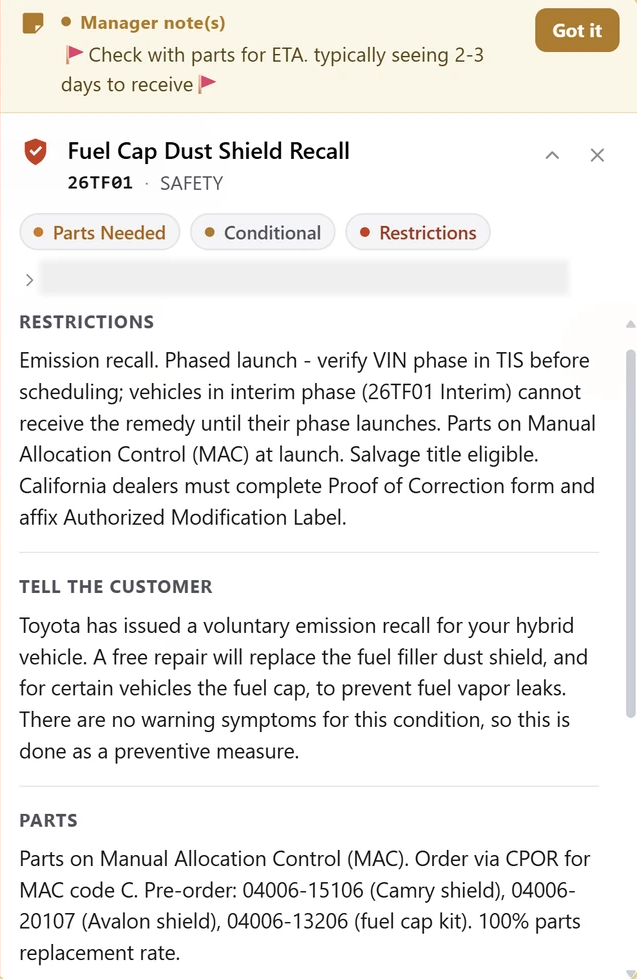
In Cox Automotive’s 2025 Service Industry Study, 45% of surveyed owners reported a frustration at the dealership, and the most common one was service taking longer than expected. Many of those surprises start at booking, before the advisor ever meets the customer. A new BDC rep who does not know that a campaign needs parts ordered first, or that an inspection could mean extra days, books a visit that goes wrong at the counter. See how to improve service CSI and CXI scores, starting at booking.
Keep the veteran’s knowledge where the new hire works
A veteran’s edge is mostly knowing the rules. The manufacturer’s warranty policy manual runs to hundreds of pages, and recall campaigns and service bulletins keep changing on top of it. Nobody new has time to read the whole thing, and they shouldn’t have to.
Each role needs a different slice of it. The BDC rep needs to know whether a campaign requires parts ordered ahead and how long the visit may take. The advisor needs the right operation code, pay type and claim details on the line. Write the store’s own rules down where the new hire will see them at the moment of work, such as “order parts before booking this campaign” or “reserve a loaner for this repair”, instead of keeping them in a veteran’s head.
A 30/60/90-day onboarding checklist
Adapt this to your store. It follows the ramp that works on a real service drive: a couple of weeks shadowing, a couple of weeks being shadowed, then on their own beside a senior advisor, with a check-in at 30, 60 and 90 days.
| Stage | New service advisor | New BDC rep | Manager and senior advisor |
|---|---|---|---|
| Weeks 1–2: shadow | Sit with a veteran on write-ups, walkarounds and customer calls. Learn the store’s pay types (customer pay, warranty, internal, service contract and prepaid maintenance), rental rules and authorizations. | Listen in on booking calls. Learn which campaigns need parts ordered ahead, how long common visits take and how to explain visit timing. | Pick the veteran the new hire shadows and the senior advisor they will sit beside. Write down the store’s rules for the campaigns you see most. |
| Weeks 3–4: get shadowed | Write ROs with the veteran watching, and correct them before each one closes. | Book calls with a veteran listening in. Capture the concern in the customer’s words, check campaigns and parts before booking, and leave the advisor a note on anything unusual. | Ask the veteran what the new hire still misses, and get it taught before they are turned loose. |
| After that: on your own, with check-ins | Run your own customers, seated next to a senior advisor. Ask before you guess, and check every RO before invoicing. | Book on your own, with a senior rep close by. Flag the questions customers ask most so the answers get written down. | Check in at 30, 60 and 90 days. Look at the new hire’s actual ROs, and pick one habit to coach at each check-in. |
Use each check-in to look at the work, not the calendar:
- Day 30, as they are turned loose: the advisor writes a concern line a technician can act on and picks the right pay type on routine lines and rentals, and the BDC rep knows which of your common campaigns need parts first. Anything missing gets more time with the veteran.
- Day 60: routine ROs close without corrections, campaign visits arrive with parts and expectations set, and you know which questions the new hire still asks the senior advisor most.
- Day 90: warranty write-ups pass review, corrections are trending down and the new hire’s CSI or CXI is in line with the team. Set the next goal.
What to measure
- Time to productivity: weeks until the new hire’s routine ROs close without corrections.
- Corrections made on open ROs, and whether the same issue keeps coming back.
- Comeback rate by advisor, compared with your store average.
- Fixed right the first time on repair visits.
- Warranty rejections and write-offs, in dollars and by cause.
- CSI or CXI for the new hire’s customers, compared with the team.
Will AI replace service advisors? Where DealerNavi fits
It’s a fair question for any manager who is short-staffed. The answer is no. AI can take over the lookup and checking, but the customer conversation, the judgment and the decisions stay with people. DealerNavi works alongside your team. It sits on top of the screens your team already uses and shows a new employee what a veteran would check at the moment it matters, including the things they don’t know to ask about.
- In the BDC: cards show campaign eligibility, parts requirements, what to tell the customer and the manager’s notes while the appointment is booked, so a new agent can set the right expectations from the first call.
- At the advisor desk: cards point out the wrong pay type, a missing operation code or missing warranty claim details on the open RO, with cause and correction text ready to copy, and a final invoice check before the customer reaches the cashier.
- For the manager: corrections made while repair orders were still open, recurring issues by advisor for coaching, and weekly trends that compare the weeks before and after a focus.
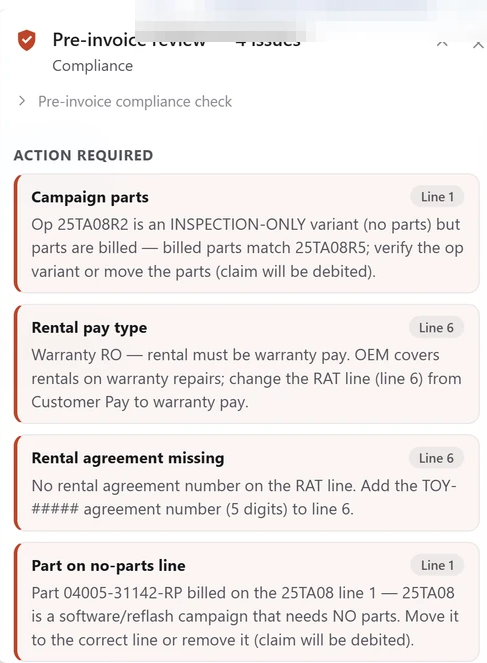
Cards make the senior advisor’s time go further. Instead of answering the same pay-type question again, they can spend it on their own customers and on the conversations that only experience teaches. Dedicated Parts and Technician modules are in development.
Get in touch See the manager reports
Questions service managers ask
How long does it take to train a new service advisor?
About a month to be on their own, and much longer to work like a veteran. In the best case, a new advisor shadows a veteran for a couple of weeks, is shadowed for a couple more, then works on their own with check-ins, seated next to a senior advisor who can answer questions. Trade-press guidance puts a new advisor close to a senior advisor’s efficiency within about a year. Measure your own: track how many weeks it takes each new hire to write routine ROs that close without corrections.
Why is there a service advisor shortage?
Most openings come from replacing people who leave, not from growth. In NADA’s Dealership Workforce Study, service advisor turnover was 43% in 2024, and only 46% of the advisors on staff had been at their dealership three years or more. Many stores are always training someone new, so getting each new hire productive sooner matters as much as hiring.
What should a service advisor onboarding checklist include?
A veteran to shadow for the first couple of weeks, a couple of weeks writing ROs with that veteran watching, a senior advisor to sit beside once the new hire is on their own, the store’s rules for pay types, rentals and authorizations, and check-ins at 30, 60 and 90 days that look at the new hire’s actual ROs.
How do you train a new BDC rep for service scheduling?
Have them listen in on booking calls for a couple of weeks, then book with a veteran listening in, then book on their own with a senior rep close by. Teach which campaigns need parts ordered before the visit, how long common visits take, and how to explain that an inspection could mean extra days. A new rep who sets realistic timing at booking saves the advisor from delivering bad news at the counter.
What are the most expensive mistakes new advisors make?
The ones they don’t know to ask about: a vague write-up that does not turn the customer’s concern or complaint into something a technician can act on, missing claim details on a warranty line, the wrong pay type, and expectations that were never set at booking. Each one is easy to fix while the RO is open. Once the RO is closed and the car is gone, it is final.
Will AI replace service advisors?
No. AI is good at the lookup and checking part of the job: finding the manufacturer’s requirement, spotting a missing claim detail or a wrong pay type, and doing it the same way on every repair order. The job itself is people work. An advisor listens to the customer, turns a vague concern into a write-up a technician can act on, explains a repair and its cost, handles the upset customer and makes the judgment calls. DealerNavi works alongside the advisor: it shows the requirements on the open RO, and the advisor decides what to do and owns every conversation.
Will AI replace BDC reps?
No. A BDC rep’s value is the conversation: reading what the customer needs, explaining why a campaign visit may take longer, setting expectations the customer will remember and turning a hesitant caller into a kept appointment. Those calls depend on judgment and trust. DealerNavi shows campaign eligibility, parts requirements and the manager’s notes beside the appointment, so even a new rep can set accurate expectations while running the call.
Sources
Figures were checked against these sources on October 13, 2026. The best-case ramp comes from 30 years of fixed ops experience. Time to veteran efficiency is published guidance, not measured data, and is labeled that way in the text. We found no credible public turnover figure for BDC reps and no neutral dollar figure for the cost of replacing an advisor, so we did not publish one.
- NADA Dealership Workforce Study, sample report (2024 data): service advisor turnover, and three-year retention, the share of active employees with three or more years at the dealership.
- Ducker Carlisle, “What to do about service advisor turnover?”, published by NADA: advisor turnover reported by manufacturers, 2018–2022.
- U.S. Bureau of Labor Statistics, Occupational Outlook Handbook: Automotive Service Technicians and Mechanics (2025–35 projections).
- TechForce Foundation, 2024 Technician Supply & Demand Report (December 16, 2024).
- CBT News, “Fix it right the first time,” by J.D. Power (August 13, 2025).
- Cox Automotive, 2025 Service Industry Study (1,974 owners surveyed April–May 2025).
- CBT News, “Proper training processes for a new service advisor” (January 4, 2018).
- Pinnacle, “How long does service advisor training take?” (October 1, 2026).
More guides
- How to catch warranty mistakes before the RO closes
- How to improve service CSI and CXI scores, starting at booking
- How to avoid warranty audit chargebacks and debits: a service manager’s checklist
- Why warranty claims get denied, and how to write a cause and correction that holds up
- How to stop wrong pay types on repair orders, including warranty rental